

Introduction
An examination of the current state of journalism has become a crucial topic of discussion among scholars in communication, journalism, and media studies, considering the ever-growing digital media, trends and emerging technologies, which poses a threat to the traditional concepts, skills, and practices of journalism.
Traditionally, journalism has been primarily focused on information gathering through activities such as interviewing, writing, and reporting. However, the rapid growth of digital media, changing trends and the emergence of new technologies have sparked scholarly discussions regarding the necessity for journalists to adapt and develop computer skills.
These computer skills include but not limited to website design, coding, and engaging in interactive news presentation through data analysis and visual storytelling. Other scholarly concerns have been the widespread calls for journalism schools to integrate these technological skills into their curriculum.
This integration is seen as essential for journalism to maintain its relevance in the current digital age and to effectively navigate the challenges posed by emerging technologies.
Key Trends in Journalism
The key trends in journalism today are multifaceted and reflective of the evolving media landscape influenced by digital platforms and emerging technologies. One prominent trend is the adaptation of journalists to new social media platforms like TikTok as noted by Negreira-Rey et. al (2022) in their article “Blurring Boundaries Between Journalists and TikTokers: Journalistic Role Performance on TikTok.”
This adaptation involves journalists adopting various roles beyond traditional reporting such as entertainers, influencers, and content creators, to engage with younger audiences on platforms like TikTok. According to the study, journalists are leveraging TikTok to reach new audiences, promote their personal brand, disseminate current information, and even provide entertainment through humorous content, challenges, and dances.
This trend about how journalists are embracing new digital platforms is mainly influenced by the adoption of social media as a news source among many people. Therefore, for journalists to remain relevant and connect with diverse audience, it has become increasingly important to establish presence on these social media platforms.
In fact, Lewis & Molyneux (2018) noted in their study “A Decade of Research on Social Media and Journalism: Assumptions, Blind Spots, and a Way Forward” that media owners are increasingly making platforms like Twitter and other social media platforms a requirement for journalists.
“In 2015, when the first author visited a U.S. metropolitan newspaper in the throes of trying to reinvent itself for the digital era, a management ultimatum had recently been delivered to the few reluctant late-adopters there: Be an active contributor on social media, or else.”
A Pew Research Center study shows the news consumption across social media platforms in 2021. The findings reveal that despite concerns about misinformation, a significant portion of Americans continue to turn to social media for news, with nearly half (48%) of U.S. adults reporting that they get news from social media either often or sometimes.

According to the study, Facebook remains the dominant platform for news consumption, with about a third (31%) of Americans regularly getting news from the site. However, there are noticeable demographic differences in the regular news consumers of various social media platforms.
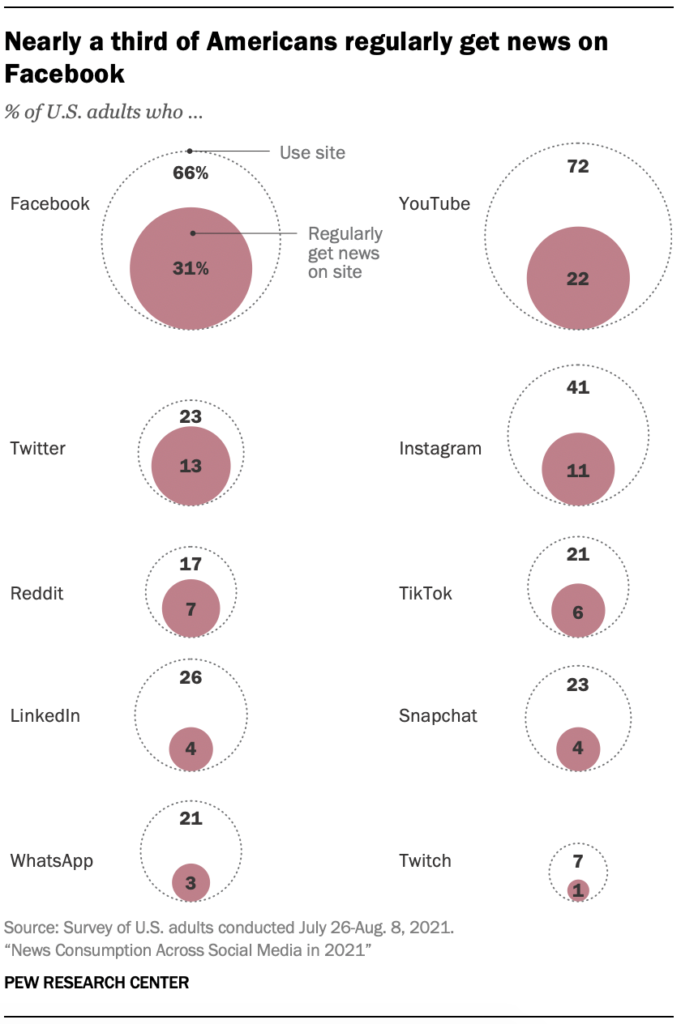
For example, White adults constitute a majority of regular news consumers on Facebook and Reddit, while Instagram attracts a more diverse audience, with significant proportions of Black and Hispanic adults among its regular news consumers.
Interestingly, Twitter stands out as a particularly “newsy” platform according to the study, with over half (55%) of its users reporting that they regularly get news there. Despite being used by a smaller proportion of U.S. adults compared to Facebook, Twitter’s users are highly engaged with news content on the platform.
Moreover, the study highlights how the share of users who regularly get news on certain platforms has remained relatively stable since 2020, with exceptions such as Facebook, which has seen a decline in the proportion of users getting news regularly. On the other hand, TikTok has experienced a slight increase in the percentage of users who report regularly consuming news on the platform.
These findings complement the trends observed in the research study on “The Journalist as Programmer” by Royal (2012) which explores how modern news organizations like The New York Times are leveraging technology to deliver interactive and data-driven news presentations. “Developing news interactives and technology tools to assist journalism functions is very different than the projects typically engaged by a software developer….”
The study by Royal (2012) shows the growing importance of programming skills in journalism, as some top newsrooms like New York Times are integrating technology into storytelling processes.
Another key trend in journalism now is the increasing emphasis on Data journalism and interactive storytelling, as discussed in “Materializing New Forms of Journalism: A Process Model“ by Doherty et. al (2022). This trend reflects a shift towards more immersive and engaging forms of journalism that leverage data visualization, multimedia elements, and interactive features to enhance storytelling and audience engagement.
As noted by Royal (2012), The New York Times, Texas Tribune, Las Vegas Sun, and The Guardian are some of the major news organizations that are leveraging Data journalism and visuals to enhance their storytelling and engage audiences in innovative.
Royal and Blasingame (2016) defines Data journalism as a “process by which analysis and presentation of data are employed to better inform and engage the public. Its roots are in the fields of computer-assisted and investigative reporting, but data journalism products may add engagement through customization and user contribution made possible by Web development and programming techniques.”
Example of Data Journalism or Interactive Presentation
The Texas Tribune’s Government Salaries Explorer page is an example of data journalism or interactive news presentation. The page provides access to salary information for Texas State employees across various government agencies. Here’s a look at the page.

The platform typically includes a search bar where users can input the name of a specific employee they are interested in knowing the salary of. For example, users can type in the name “Greg Abbott” or the name of a specific agency like “Health and Human Services Commission” to retrieve relevant salary information. See below;

Upon selecting a specific employee or agency, users are presented with individual profiles or summaries that provide details about the employee’s position, department, and salary.

Need for Journalism Schools to Adapt to Data and Programming
Considering the trends in digital media and emerging technologies, it’s evident that data and programming skills are becoming increasingly important in journalism today. These skills are essential for journalists to remain competitive and effective in their field.
Gone are the days when journalists relied solely on interviews and official statements to craft their stories. In the contemporary media landscape, data journalism and interactive storytelling have revolutionized the way stories are told, offering deeper insights into complex issues.
As noted by Royal & Blasingame (2016), “the role of “big data” is expected to continue shaping journalism, making it imperative for journalism schools to equip students with these skills to meet the demands of the evolving job market.”
Royal further noted in her work “Thinking Critically About New Media” that a growing number of media jobs include the requirements of understanding web design, coding, and various technical skills. Therefore, media curriculum that includes traditional media skills alongside these technical proficiencies is essential to meet the demands of the growing digital, interactive, or new media landscape.
To ensure that students are equipped with these skills, journalism schools must have faculty members who possess expertise not only in journalistic writing and storytelling but also in data analysis, programming, website design, and other relevant computer software skills.
By adapting their curricula to encompass these technical proficiencies, journalism schools can ensure that graduates are well-equipped to navigate the complexities of modern journalism and contribute meaningfully to the evolving media landscape.
